The top Korean profanity; fuck-equivalent root.
Ssibal literally points at sex. The accepted derivation (National Institute of Korean Language) runs from 씹하다 (ssip-hada), a vulgar verb “to have sexual intercourse”, through the older Seoul form 씹할/씨팔, to modern 씨발. You will often hear it explained as “prostitute” — Korean reference sources themselves label that a folk etymology, not the real one.
In daily life the literal meaning is mostly worn off. Ssibal works the way fuck does at its most bleached: an exclamation of frustration, an intensifier, a piece of punctuation. Its clipped front end — 씨 (ssi), 아이씨 (aissi) — is what many people actually say out loud.
Two syllables, SHI-bal: a hissing tense-ss start and a hard stop at the end. It is built to be spat out.
The corpus record shows how it is really used. In the National Institute of Korean Language’s 2011 recorded-conversation corpus (540 students, about 239,000 words), 씨발 appeared 446 times and its clipped interjection 씨 another 132 — and the researchers group it with the degree-words and interjections, not with insults. Its commonest live function is venting and emphasis, not attack.
Bare. “아이 씨발!” at a stubbed toe or a missed train: pure venting, the weakest and commonest form. Korea’s Supreme Court treated exactly this use as no insult at all (24 December 2015, case 2015도6622): shouting it at a police officer during a taxi-fare dispute did not devalue a specific person, so it was not criminal insult.
In a sentence. As an intensifier it behaves like “fucking”, stuck in front of whatever annoyed you. This use is the word’s centre of gravity in the data.
Directed. Compounded at a named person — 씨발놈, 씨발년, “씨발 새끼” — the picture flips: reported lower-court cases sustain insult convictions for these forms, with fines of ₩300,000–₩1,000,000. The mother-compounds (니미씨발 and the wider 패드립 family) are the escalation tier Koreans reach for when they want maximum anger — though no study has yet scored them head-to-head against plain ssibal.
Softened. 씨, 아이씨, 시바/씨바, 십팔 (“eighteen”, a sound-alike pun) and 신발 (“shoes”). These evasions exist precisely because the full form is still taboo — the same way “effing” presupposes fuck.
Among friends, the bare word costs almost nothing: ssibal is simultaneously Korea’s most-used and most-condemned youth profanity. The NIKL+KBS survey of September 2011 (n=1,518, ages 14–19) put the ssibal family first for “most used” (25.4%) and first for “should not be used” (31.3%).
Aim it at an identifiable person in public and the cost becomes legal. Insult (모욕죄, Criminal Act Article 311) carries up to one year in prison or a ₩2,000,000 fine, and directed compounds draw the real fines noted above. On broadcast, an unscripted “이씨, 씨발” from a home-shopping host drew a statutory sanction (경고, a formal warning) from the broadcast regulator KCSC in October 2023 — the only statutory sanction in that announcement, while 존나-family words and 병신 on other channels received non-statutory guidance only. Upward use — to elders, teachers, bosses — stays socially explosive even as the exclamation deflates.
Squid Game alone uses ssibal 55 times (Lee 2022’s count of its 323 swear tokens). The telling detail is what the official English subtitles did with those 55: full force kept only 38.2% of the time, weakened to things like “damn” or “shit” 45.5%, dropped entirely 16.4%. Japanese subtitles kept full force 0% of the time.
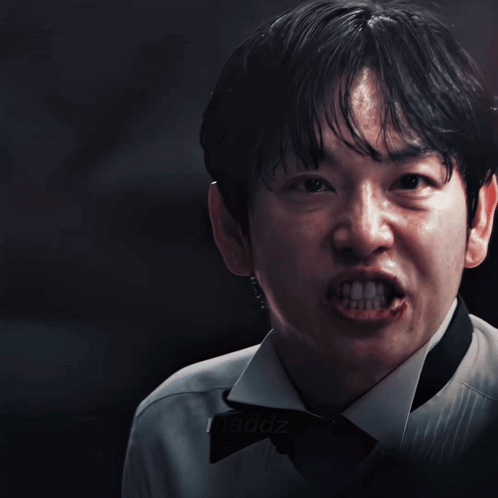
Translators downgrade ssibal because its habitual Korean force is weaker than its dictionary rank — nobody in Seoul hears it quite the way an English speaker hears a fresh “fuck”. The scene still on this page is from Squid Game.
Native Shorts — to be collected
How is it really pronounced — and where do you actually use it?
No threads yet. Be the first to post about ssibal.
Evidence: Measured — top grade in Korean severity scales (2022; joint 5/5 in 2011).